The great acceleration
This is the first essay in a series about living with AGI in society
Time does not flow evenly through history. Some years contain more transformation than entire centuries.
We are living in such a year, and we can watch it unfold in real time.
Present tense
Earlier this week, OpenAI, SoftBank, Oracle, and MGX announced a $500 billion investment in AI infrastructure, pitched as the largest industrial mobilization since World War II. They called it The Stargate Project, and its goal was explicit: to build the foundation for artificial general intelligence. The present is rushing to meet a future that’s arriving faster than anyone expected.
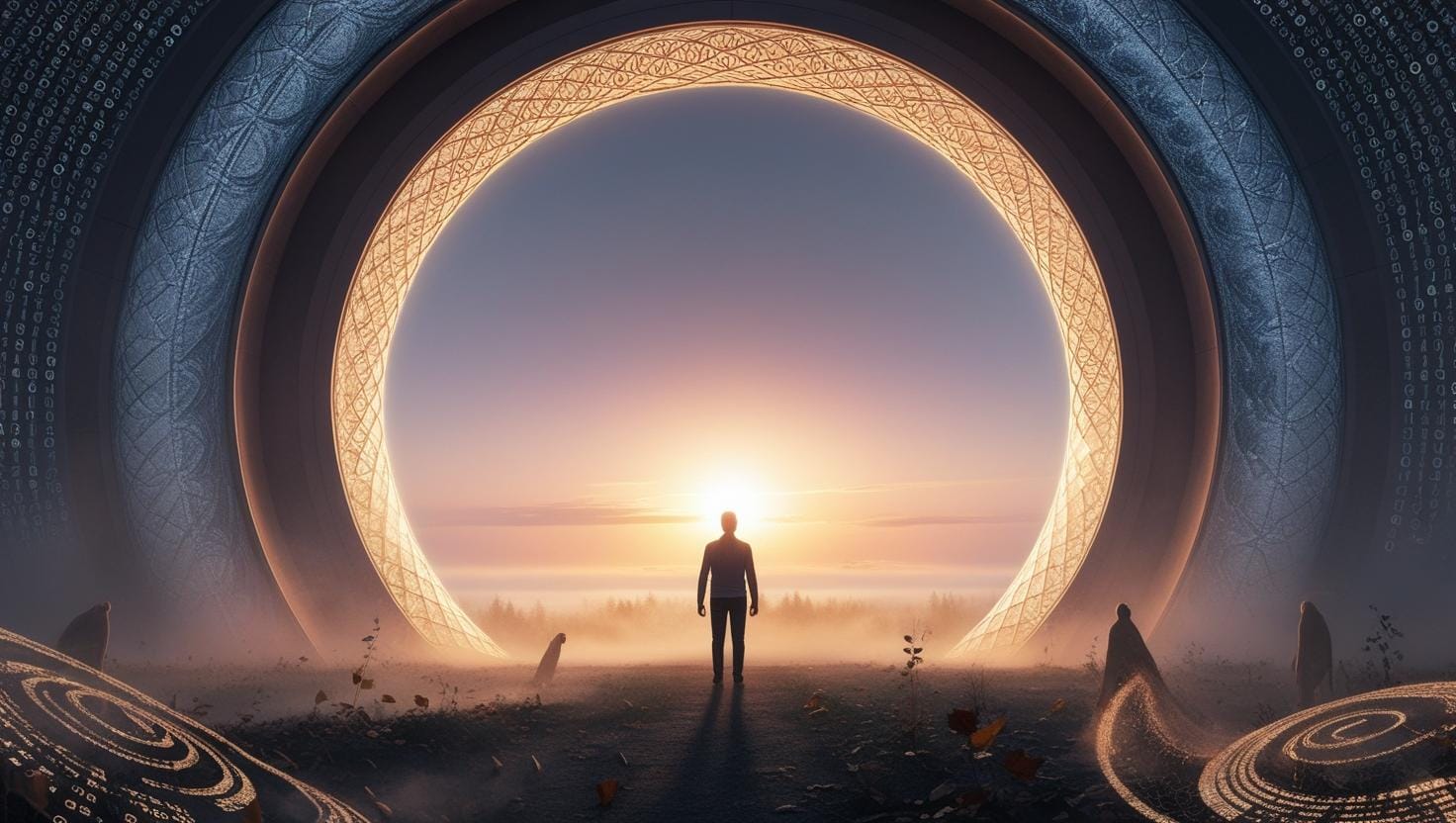
Patterns emerging
Most people still see artificial intelligence as a gradual progression of better software. They notice chatbots writing clearer text, image generators creating sharper pictures, coding assistants offering smarter suggestions. What they don’t yet grasp is the speed and scale of what’s coming, or the thing that makes this moment different from every other technological revolution in human history: for the first time, the forces driving machine intelligence follow curves we can measure and extrapolate.
Look at what four years brought us: from GPT-2 to GPT-4, an estimated hundred-thousand-fold increase in effective compute. Systems that could barely mimic human writing became ones that can reason through complex problems, write sophisticated code, and display expert-level understanding across dozens of fields. That wasn’t luck or a singular breakthrough; it was the product of patterns as relentless as compound interest.
Acceleration begins
These patterns show us what comes next. Each doubling of compute brings predictable gains, and each increase in scale reveals new capabilities. The same forces that turned stumbling language models into reasoning engines are still compounding.
The people closest to the technology are seeing the acceleration most clearly. Anthropic CEO Dario Amodei, known for careful understatement, now says he is more confident than ever that we are very close to powerful AI capabilities. The confidence comes from watching these patterns play out in his own lab.
By 2025, artificial intelligence will match and exceed the capabilities of college graduates. When machines can learn in seconds what takes humans years to master, every institution built around human learning and expertise will need to reinvent itself.
By 2027, these systems will surpass human experts in most intellectual domains. Every profession that relies on human cognitive ability will be transformed.
Transformation accelerates
When these systems reach human-level capability in AI research, they’ll begin improving themselves. Each generation will be more capable than its creators, and the feedback loop will produce a leap unlike anything in our species’ history: the birth of minds that can improve themselves without limit.
The acceleration will trigger cascading changes through every layer of society. Economic systems built around human labor and expertise will transform in years rather than decades. Social structures that evolved over centuries will need to adapt in months, and cultural assumptions about intelligence, consciousness, and human uniqueness will face challenges we can barely imagine.
The entire accumulated knowledge of human civilization will become the starting point for artificial minds that can process, expand, and reinvent it at digital speeds.
Our moment
We’re building humanity’s intellectual successors. The acceleration is visible now: in the industrial buildout, in the growing certainty of the people closest to the work, in capabilities that keep exceeding predictions.
You live in this moment. You’re witnessing the last years of humanity’s solo journey and the first steps toward something entirely new. The greatest leap in the history of intelligence is arriving with the force of exponential growth.
We can measure the technological progression with precision, but the cascading effects will exceed our ability to predict. The changes will ripple through every part of human existence, including how we understand ourselves and our place in the universe.
We stand at the threshold of the most significant transition in human history, and we get to witness and shape the birth of something unprecedented in the cosmos: intelligence that can improve itself, minds that aren’t limited by biology. The challenge is to make sure the transition fulfills its promise while preserving what makes us human.
Welcome to the Great Acceleration. It’s already here.