The GenAI application layer
As the Head of Generative AI Product at Canva, I have a front-row seat to how AI is changing creative work: millions of people designing things that used to be out of their reach. That experience has shaped my view of the biggest opportunities for early-stage startup founders in 2024 and beyond.
The four layers
The AI ecosystem breaks down into four layers:
- Semiconductors: the foundation, where NVIDIA and the other chipmakers build the GPUs and specialized chips that AI computation runs on. Generally sold on a unit basis.
- Infrastructure: AWS, Google Cloud, and Microsoft Azure, providing the compute needed to run AI at scale. Sold on usage.
- Models: the foundation models that power AI applications, from OpenAI and Anthropic to Google’s Gemini and AWS’s Bedrock. Also sold on usage, usually with the compute bundled in.
- Applications: where AI gets woven into specific products. This is where Canva operates, building AI into our design platform. Priced on the value provided to end users.
So far the lion’s share of revenue and profit has accrued at the semiconductor and infrastructure layers. Apoorv Agrawal’s The Economics of Generative AI does a great job outlining the value chain today and how he expects it to shift.
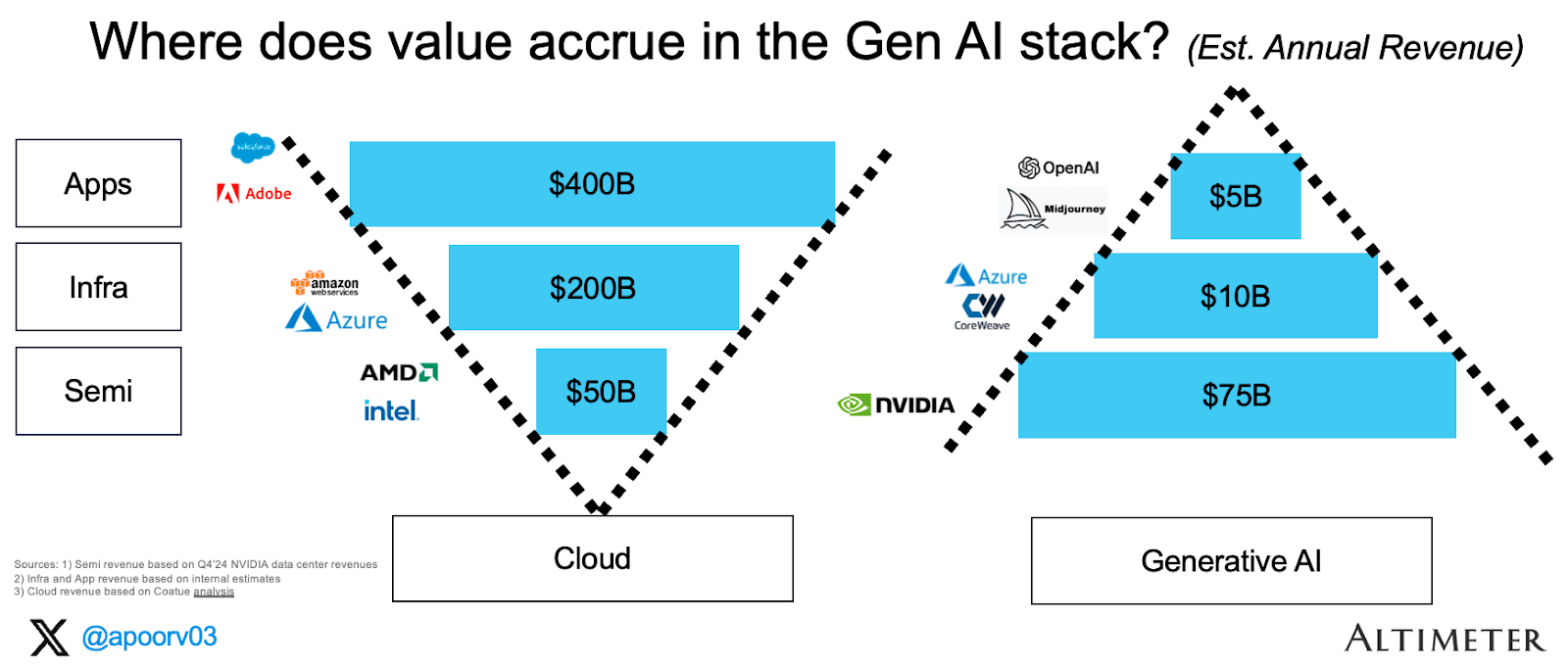
Estimated annual revenue by layer, cloud versus generative AI. Via @apoorv03 at Altimeter.
If history is any indication, the vast majority of the opportunity over the next decade sits at the application layer.
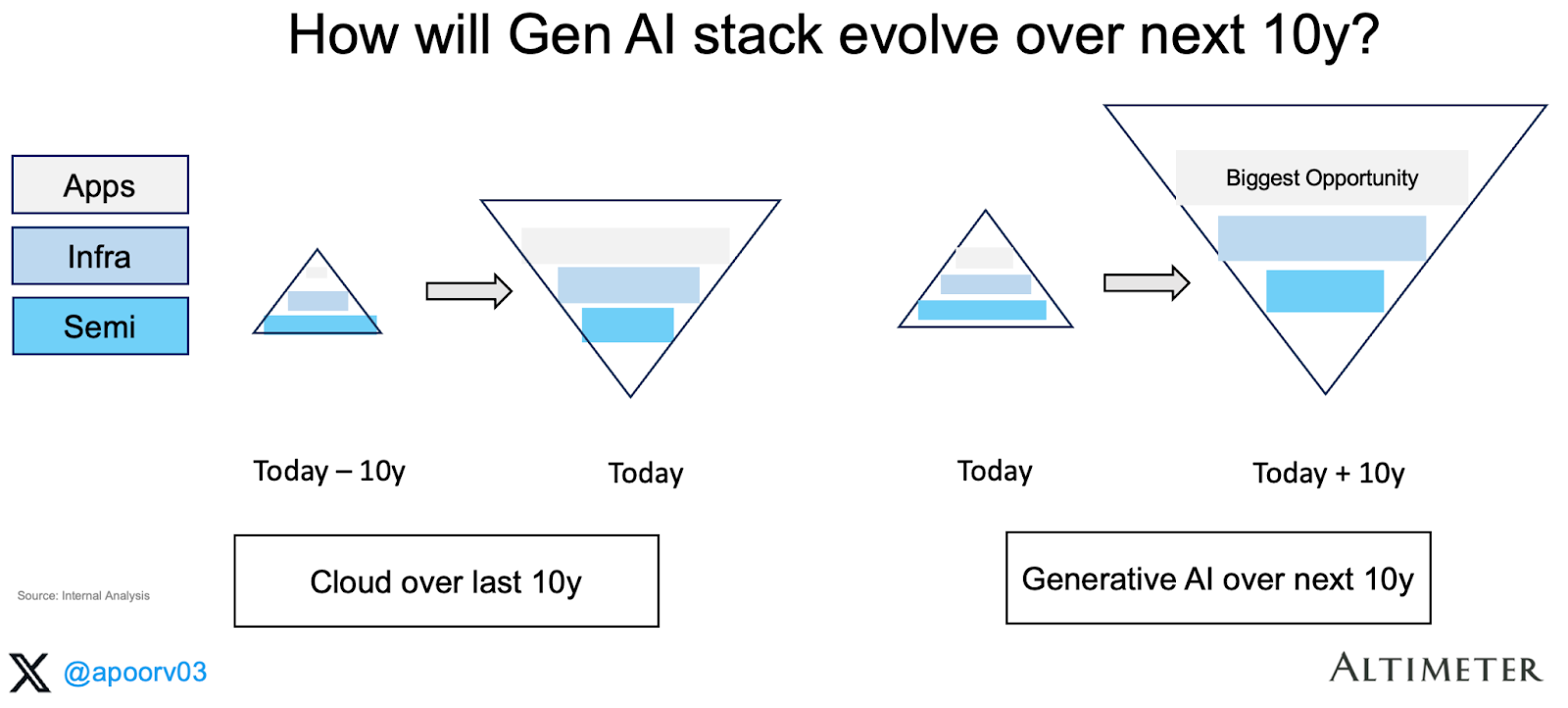
Via @apoorv03 at Altimeter.
AI-native applications
The most interesting companies here are AI-native: products built from the ground up with AI at their core. A few examples that have caught my eye:
- GitHub Copilot: the AI coding assistant accounted for over 40% of GitHub’s revenue growth in 2023.
- Jasper: the AI writing platform reached a $1.5 billion valuation less than two years after launch.
- Harvey: AI-powered research and analysis built specifically for legal work. Focusing on one industry and tailoring the product to it is how an AI application creates real value in a niche market.
Why I’m betting on the application layer
As an investor and advisor, I’m most excited about companies at the application layer:
- Model agnosticism: they benefit from improvements across every model provider, so the product gets better as the underlying technology does.
- Value beyond the model: the good ones solve a whole problem rather than putting a thin interface on someone else’s API.
- Data advantage: every interaction produces data that improves the product and attracts more users.
- Specialization: general-purpose AI is powerful, but the value goes to products tailored to a specific industry or use case.
Having watched this play out firsthand at Canva, I want to support the next wave of founders building here, especially the ones whose AI-native products solve specific, high-value problems in traditional industries.
The road ahead
We’re at the beginning of a new era, and the companies that put AI to work on those problems will be the ones that shape it. The open question is who will lead. Will it be the established tech giants pivoting to AI, or startups unencumbered by legacy systems? Will it happen in the fields we expect, like software development and creative work, or in industries we haven’t even considered? Either way, the impact will reach well beyond the tech world.